




Sign up to Ullapool Box Creations email Newsletter
Sign up below to keep up to date with our latest news, products and commissions.

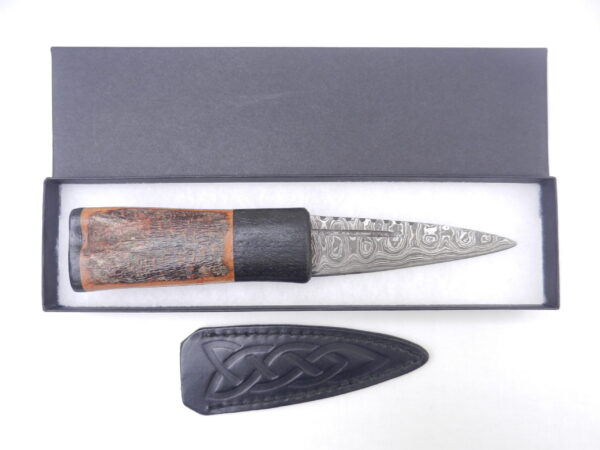

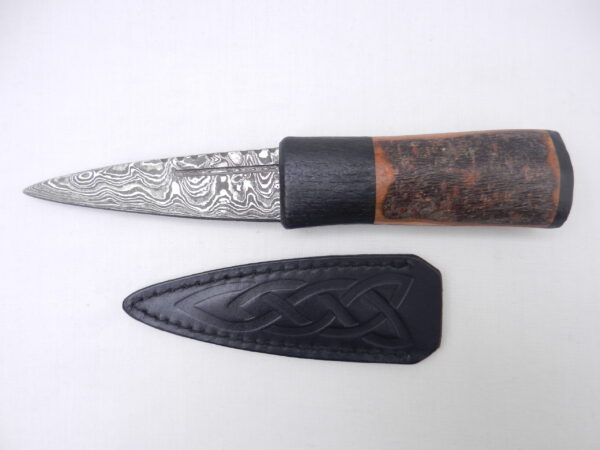


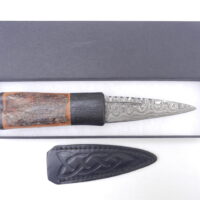

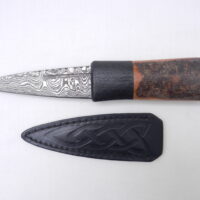


Natural Blackthorn Damascus Sgian Dubh with local Bog Oak and Brazilian Purpleheart centre
The Sgian Dubh is a ceremonial dagger that is traditionally worn (tucked into the sock) as part of Scottish Highland dress along with a kilt. The translation in Gaelic is knife or dagger for “Sgian” and black for “Dubh”.
The primary handle of this Sgian Dubh is made from some local Blackthorn. I coppiced this piece of Blackthorn in Ullapool only a few hundred meters away form the Sea Loch of Lochbroom. I must admit i have had a bit of an obsession with this wood since starting my wood journey some 11 years ago. There is no other Scottish hardwood that is as steeped in mythology and folklore as Blackthorn. The plant itself has numerous medicinal uses and of course the Sloe berries it produces are used to make and flavour Sloe Gin. The wood is the hardest indigenous Scottish wood and for this reason was the wood of choice for the Irish Shillelagh. The bark is a blackish purple and the wood is a light brown to orange brown with an attractive grain. Very slow drying is required as with most very hardwoods otherwise the wood will literally shatter internally rendering it useless. The bark was covered in lichen and is rather scaly so it took some careful work to reveal its true beauty.
I have combined the Blackthorn with some Scottish Bog Oak. I have been very aware of this materials existence for some time now but have been waiting to secure the right piece. This particular piece came from Muir of Clunes, 12 miles South West of Inverness. This is quite a rural, verdant and quite thickly wooded part of Scotland. My contact for this wood excavated quite a few pieces and had a very small section scientifically aged, it came back at approximately 5000 years old! To put this into context, this is when, slightly further down the road, Stonehenge was starting to be assembled. Bog Oak is created when the tree is buried in a peat bog and the wood is preserved by the acidic conditions. The wood is stained dark brown to black by the tannins in the acidic water. There is a fair amount of wastage of the wood until you get deeper into the piece. In its raw state it smells like a mix of rubber and organic material, not in any way rotten or decomposed. Working the wood is somewhat challenging, quite splintery very much like Snakewood or Ebony and is number 80 in my list of worked Hardwoods. Finished, the wood is at least as hard as fresh Oak and finishes to a fine lustre. Colour is predominately black with dark brown that has a deep iridescence and looks almost identical to Indian Ebony. There is no darker Scottish hardwood. I sculpt the Bog Oak until in joins perfectly and seamlessly with the Blackthorn and again smooth off any sharp edges.
For a professional finish i have used some Brazilian Purpleheart for a centre to lock the tang and the outer scales together. One of the most recognisable woods out there, Purpleheart in the heartwood of what can be quite a large tropical tree. An unassuming brown when freshly cut and worked, the secret is to put the finished piece in the sunlight, the UV rays change the colour of Purpleheart to a beautiful amaranth purple with a purple iridescence.
I love the natural look of this piece and the feel and tactility when in the hand is amongst the most satisfying of all my knives. This knife is my first new design for 2025.
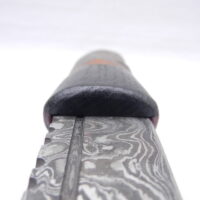
The blade is made of Damascus steel. Damascus steel was first made over 2000 years ago and has a legendary status, it is referred to as the steel of the Ancients. It is thought to have originated in or near Damascus, Syria. During the Crusades, the Crusaders where in awe of this steel that they witnessed slicing through their own lesser quality swords. The exact process of making Damascus steel was lost around 1750 AD but it became very popular again in the 1970s with various craftsmen claiming to have rediscovered the process. The process involves taking multiple layers of metal and folding them together and bonding them by forge welding. If done correctly the metalsmith will end up with a blade that is both hard and flexible and of course have the swirling Damascus steel pattern that is so sought after. Each blade has its own unique pattern, just like a finger print. I have sourced top quality 15N20 Damascus steel blanks, they have a higher Nickel content for extra hardness and are simply stunning to look at, an absolute must have for any knife collection. If Damascus steel is ground to sharpen then the pattern will disappear, to people unfamiliar with this metal, quite a distressing thing. After sharpening, application of hydrochloric acid will instantly make the pattern pop again. There is one draw back with Damascus steel, due to the high carbon content it will rust and rust quickly. If the blade gets wet it must be dried quickly and if stored for a period of time, especially in an environment that could get damp, simply rub a little clear oil onto the blade to protect it. I have set it in the handle so that it measures just under 3.5″ to comply with current UK knife laws.
To finish and protect the wood I first apply a sealer of Shellac and Cellulose Thinners, this brings out the true colours in the wood. I then apply to types of industrial wax, the same finish as I use on my antler pieces, this leaves a hard wearing satin sheen.
It comes complete with an attractive embossed black leather sheath and a black presentation box. The Sgian Dubh measures:
Overall Length 176mm x Width 32mm x Depth 20mm
Blade Length 86mm x Width 24mm
As with all of my pieces i have applied my company logo “UBC” with pyrography, in this case on the bottom rear of the handle.
£95.00
Out of stock
Sign up to Ullapool Box Creations email Newsletter
Sign up below to keep up to date with our latest news, products and commissions.
